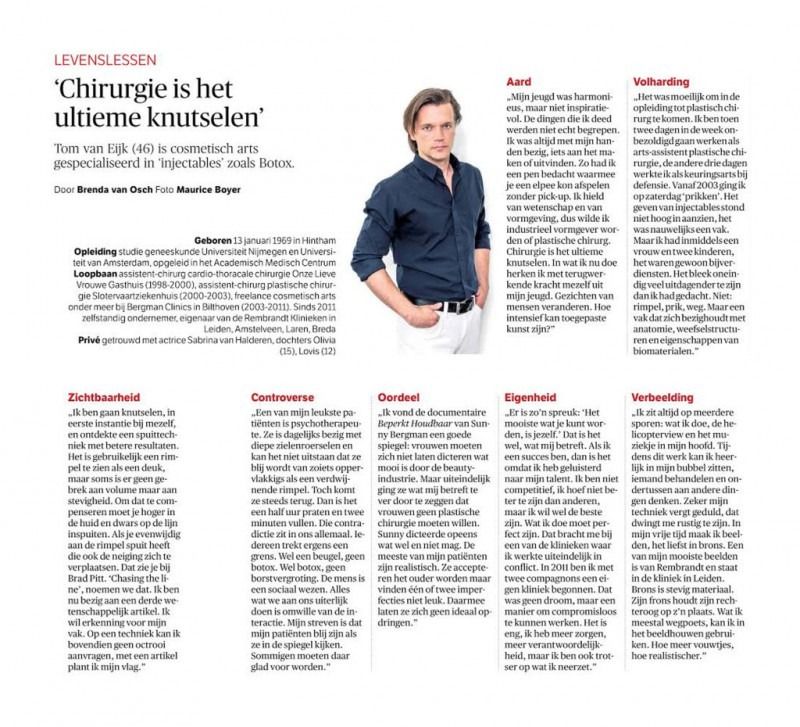
Tom van Eijk (46) is a cosmetic doctor specializing in `injectables’ such as Botox.
By Brenda van Osch, Photo Maurice Boyer
Born: January 13, 1969 in Hintham
Education: studied medicine University of Nijmegen and University of Amsterdam, trained at the Academic Medical Center
Career: assistant surgeon in cardiothoracic surgery Onze Lieve Vrouwe Gasthuis (1998-2000). assistant surgeon in plastic surgery Slotervaartziekenhuis (2000-2003), freelance cosmetic doctor including at Bergman Clinics in Bilthoven (2003-2011), De Clinique in Den Bosch and Esthetisch Centrum jan van Goyen in Amsterdam.
Private: married to actress Sabrina van Halderen, daughters Olivia (15), Lovis (12)
Nature
“My childhood was harmonious, but not inspirational. The things I did were not really understood. I was always working with my hands, making or inventing something. For example, I had invented a pen that allowed you to play an album without a pickup. I loved science and design, so I wanted to be an industrial designer or a plastic surgeon. Surgery is the ultimate in tinkering. In what I do now, I retroactively recognize myself from my youth. Changing people’s faces. How intense can applied art be?”
Volharding
“It was difficult to get into training as a plastic surgeon. I then started working two days a week unpaid as a plastic surgery physician’s assistant, the other three days I worked as a medical examiner for the military. As of2003, I started “poking” on Saturdays. Giving injectables was not highly regarded; it was hardly a profession. But by now I had a wife and two children; it was just keep working. It turned out to be infinitely more challenging than I had thought. Not: wrinkle, prick, gone. But a profession dealing with anatomy, tissue structures and properties of biomaterials.”
Visibility
I started tinkering, initially with myself, and discovered a spray technique with better results. It is common to think of a wrinkle as a dent, but sometimes there is a lack not of volume but of firmness. To compensate for that, you have to inject higher in the skin and perpendicular to the line. If you inject parallel to the wrinkle it also tends to move. You see that with Brad Pitt. `Chasing the line,’ we call it. I am now working on a third scientific paper. I want recognition for my profession. Besides, I cannot patent a technique; with an article I plant my flag.”
Controversy
“One of my nicest patients is a psychotherapist. She deals with deep soul stirrings daily and can’t stand to be delighted by something as superficial as a disappearing wrinkle. Yet she keeps coming back. Then it’s half an hour of talking and two minutes of filling. That contradiction is in all of us. Everyone draws a line somewhere. Yes braces, no botox. Yes botox, no breast augmentation. Man is a social being. Everything we do to our appearance is for the sake of interaction. My aspiration is that my patients are happy when they look in the mirror. Some have to become smooth for that.”
Verdict
“I thought Sunny Bergman’s documentary Limited Durability was a good mirror: women should not let the beauty industry dictate what is beautiful. But ultimately, in my opinion, she went too far by saying that women should not want plastic surgery. Sunny suddenly dictated what is and is not allowed. Most of my patients are realistic. They accept getting older but don’t like one or two imperfections. With that, they don’t let an ideal be imposed on them.”
Individuality
”There’s one of those sayings: ‘The greatest thing you can become is yourself.” It is, as far as I’m concerned. If I’m a success, it’s because I listened to my talent. I’m not competitive, I don’t have to be better than others, but I do want to be the best. What I do has to be perfect. That eventually brought me into conflict at one of the clinics I worked at. In 2011, I started my own clinic with two associates. That was not a dream, but a way to work uncompromisingly. It’s scary, I have more worries, more responsibility, but I’m also more proud of what I put down.”
Imagination
“I’m always on multiple tracks: what I’m doing, the helicopter view and the music in my head. During this work, I can be wonderful in my bubble, treating someone and thinking about other things in the meantime. Certainly my technique requires patience, which forces me to be calm. In my spare time I make sculptures, preferably in bronze. One of my most beautiful statues is by Rembrandt and stood in the clinic in Leiden. Bronze is solid material. His frown holds his right eye in place. What I usually brush away, I can use in sculpting. The more creases, the more realistic.”